Wednesday, 10 July 2019

On The Invention of Fanaticism

The British scientist and philosopher J.B.S Haldane counts religious intolerance among the only four really important inventions made between 3000 B.C. and 1400 A.D. In his essay, “Is History A Fraud?” (Page 56; The Inequality of Man and Other Essays by J.B.S Haldane), he writes:
“Between 3000 B.C. and A.D. 1400 there were probably only four really important inventions, namely the general use of iron, paved roads, voting, and religious intolerance. Perhaps I should have added coinage and long-distance water supply. Gunpowder had been known for a long time before A.D. 1400 in China, but did not begin to win battles in Europe till the seventeenth century. Some­ what before that date, however, it had helped to acceler­ate the decay of feudalism by diminishing the military value of castles.”
I am not a fan of Haldane, but it is an interesting thought that fanaticism which is widely seen as a cause of political violence in our times was in the early days of civilization a miraculous instrument for energizing men and inspiring them to give rise to new societies and nations. The first major nations in the history of humanity were the creation of the religious fanatics.

Tuesday, 9 July 2019

Hoffer on the Rise of New Fanatical Faiths

Eric Hoffer in True Believer:

"A wide diffusion of doubt and irreverence thus leads often to unexpected results. The irreverence of the Renaissance was a prelude to the new fanaticism of Reformation and Counter Reformation. The Frenchmen of the enlightenment who debunked the church and the crown and preached reason and tolerance released a burst of revolutionary and nationalist fanaticism which has not abated yet. Marx and his followers discredited religion, nationalism and the passionate pursuit of business, and brought into being the new fanaticism of socialism, communism, Stalinist nationalism and the passion for world dominion."

"When we debunk a fanatical faith or prejudice, we do not strike at the root of fanaticism. We merely prevent its leaking out at a certain point, with the likely result that it will leak out at some other point. Thus by denigrating prevailing beliefs and loyalties, the militant man of words unwittingly creates in the disillusioned masses a hunger for faith. For the majority of people cannot endure the barrenness and futility of their lives unless they have some ardent dedication, or some passionate pursuit in which they can lose themselves. Thus, in spite of himself, the scoffing man of words becomes the precursor of a new faith."

On The Problem of Contradictions

It is easy to proclaim that contradictions cannot exist in nature, but it is impossible to resolve the contradictions in your own philosophy. There is not a single philosophy in the last three years that is not full of contradictions. The process of identifying the contradictions in the work of a good philosopher can involve a multitude of scholars working over a period of centuries—these contradictions are never resolved. The contradictions cannot be resolved. A philosophy without contradictions is not possible to mankind. The quest for a philosophy free from contradictions is as futile as the quest for the mythical city of gold, El Dorado.

Monday, 8 July 2019

On Woolf’s To The Lighthouse

Virginia Woolf's writing style can be compared with that of Marcel Proust; she was an admirer of Proust, while she disliked James Joyce for his “whirls of obscenity”. Here's a scene from Woolf's To The Lighthouse (Part II, “Time Passes”; Chapter 3):

"But what after all is one night? A short space, especially when the darkness dims so soon, and so soon a bird sings, a cock crows, or a faint green quickens, like a turning leaf, in the hollow of the wave. Night, however, succeeds to night. The winter holds a pack of them in store and deals them equally, evenly, with indefatigable fingers. They lengthen; they darken. Some of them hold aloft clear planets, plates of brightness. The autumn trees, ravaged as they are, take on the flash of tattered flags kindling in the gloom of cool cathedral caves where gold letters on marble pages describe death in battle and how bones bleach and burn far away in Indian sands. The autumn trees gleam in the yellow moonlight, in the light of harvest moons, the light which mellows the energy of labour, and smooths the stubble, and brings the wave lapping blue to the shore.

"It seemed now as if, touched by human penitence and all its toil, divine goodness had parted the curtain and displayed behind it, single, distinct, the hare erect; the wave falling; the boat rocking; which, did we deserve them, should be ours always. But alas, divine goodness, twitching the cord, draws the curtain; it does not please him; he covers his treasures in a drench of hail, and so breaks them, so confuses them that it seems impossible that their calm should ever return or that we should ever compose from their fragments a perfect whole or read in the littered pieces the clear words of truth. For our penitence deserves a glimpse only; our toil respite only.

"The nights now are full of wind and destruction; the trees plunge and bend and their leaves fly helter skelter until the lawn is plastered with them and they lie packed in gutters and choke rain pipes and scatter damp paths. Also the sea tosses itself and breaks itself, and should any sleeper fancying that he might find on the beach an answer to his doubts, a sharer of his solitude, throw off his bedclothes and go down by himself to walk on the sand, no image with semblance of serving and divine promptitude comes readily to hand bringing the night to order and making the world reflect the compass of the soul. The hand dwindles in his hand; the voice bellows in his ear. Almost it would appear that it is useless in such confusion to ask the night those questions as to what, and why, and wherefore, which tempt the sleeper from his bed to seek an answer."

Sunday, 7 July 2019

On Modernity & Atheism

Modernity and atheism do not mix well. In the last 250 years the movements led by atheist politicians and intellectuals promised to establish a utopia of reason, science, and liberty, but on attaining power they unleashed a reign of terror and established a socialist and racist regime. The atheistic regimes have the record of prosecuting more people of other religions and races than most normal democratic governments. The important learning of last 250 years is that all atheists are potential jacobins and bolsheviks—they cannot be trusted with political power.

Saturday, 6 July 2019

Selfishness is Not a Virtue

Wanderer above the Sea of Fog 
Eric Hoffer did not regard selfishness as a virtue. He belittles the idea of selfishness in Chapter 7, “The Inordinately Selfish,” of his book The True Believer: Thoughts on the Nature of Mass Movements. He writes:
The inordinately selfish are particularly susceptible to frustration. The more selfish a person, the more poignant his disappointments. It is the inordinately selfish, therefore, who are likely to be the most persuasive champions of selflessness. 
The fiercest fanatics are often selfish people who were forced, by innate shortcomings or external circumstances, to lose faith in their own selves. They separate the excellent instrument of their selfishness from their ineffectual selves and attach it to the service of some holy cause. And though it be a faith of love and humility they adopt, they can be neither loving nor humble. 
In his book The Passionate State of Mind: And Other Aphorisms (Chapter 5, “The Readiness to Work”), Hoffer notes that selfishness subsumes self-abnegation:
There is even in the most selfish passion a large element of self-abnegation. It is startling to realize that we call extreme self-seeking is actually self-renunciation. The miser, health addict, glory chaser and their like are not far behind in the exercise of self-sacrifice. Every extreme attitude is a flight from the self.

Philosophical Movements Have Unintended Consequences

Philosophical movements have unintended consequences. A movement dedicated to the cause of brotherhood of man may lead to jealousy and factionalism. A movement dedicated to the cause of individualism and happiness may lead to collectivism and misery. A movement dedicated to the cause of reason may lead to irrationality and mysticism. A movement dedicated the cause of freedom may lead to groupthink. Only the philosophers who are hungry for power over others and have a delusional view of human psychology waste their time on movements.

Wednesday, 3 July 2019

On The Atmosphere of Officialdom

“The atmosphere of officialdom would kill anything that breathes the air of human endeavor, would extinguish hope and fear alike in the supremacy of paper and ink.” ~ Joseph Conrad in The Shadow-Line

Tuesday, 2 July 2019

Joseph Conrad On The Supernatural

When Joseph Conrad’s The Shadow-Line was published in 1916, the critics noted that the novella was a fantasy because in it the previous captain’s ghost is haunting the ship on which the story takes place. In the second edition of the book, which came in 1920, Conrad appended an Author’s Note in which he mounted a defense of natural world, noting that the world “contains enough marvels and mysteries as it is… I am too firm in my consciousness of the marvelous to be ever fascinated by the mere supernatural.” Here’s an excerpt from Conrad’s Author’s Note:

“This story, which I admit to be in its brevity a fairly complex piece of work, was not intended to touch on the supernatural. Yet more than one critic has been inclined to take it in that way, seeing in it an attempt on my part to give the fullest scope to my imagination by taking it beyond the confines of the world of the living, suffering humanity. But as a matter of fact my imagination is not made of stuff so elastic as all that. I believe that if I attempted to put the strain of the Supernatural on it it would fail deplorably and exhibit an unlovely gap. But I could never have attempted such a thing, because all my moral and intellectual being is penetrated by an invincible conviction that whatever falls under the dominion of our senses must be in nature and, however exceptional, cannot differ in its essence from all the other effects of the visible and tangible world of which we are a self-conscious part. The world of the living contains enough marvels and mysteries as it is; marvels and mysteries acting upon our emotions and intelligence in ways so inexplicable that it would almost justify the conception of life as an enchanted state. No, I am too firm in my consciousness of the marvelous to be ever fascinated by the mere supernatural, which (take it any way you like) is but a manufactured article, the fabrication of minds insensitive to the intimate delicacies of our relation to the dead and to the living, in their countless multitudes; a desecration of our tenderest memories; an outrage on our dignity.”

The ghost of the previous captain (a man called Mr. Burns) is described by one of the inmates of the ship in these words: “His face in the full light of day appeared very pale, meagre, even haggard. Somehow I had a delicacy as to looking too often at him; his eyes, on the contrary, remained fairly glued on my face. They were greenish and had an expectant expression."

Saturday, 29 June 2019

Jung On The Stages of Life

Carl Gustav Jung, in his essay, “The Stages of Life,” (Chapter 1; The Portable Jung, Edited by Joseph Campbell; translated by R. F. C. Hull), points out that there are four stages in a man’s life, and he talks about the physiological issues that arise as a man transitions from one phase of life to other. Here’s an excerpt in which he is using the analogy of the sun’s motion to describe the difficulty a man faces in transitioning from the phase of mature adulthood to extreme old age:
"Experience shows us, rather, that the basic cause of all the difficulties of this transition is to be found in a deep-seated and peculiar change within the psyche. In order to characterize it I must take for comparison the daily course of the sun—but a sun that is endowed with human feeling and man's limited consciousness. In the morning it rises from the nocturnal sea of unconsciousness and looks upon the wide, bright world which lies before it in an expanse that steadily widens the higher it climbs in the firmament. In this extension of its field of action caused by its own rising, the sun will discover its significance; it will see the attainment of the greatest possible height, and the widest possible dissemination of its blessings, as its goal. In this conviction the sun pursues its course to the unforeseen zenith—unforeseen, because its career is unique and individual, and the culminating point could not be calculated in advance. At the stroke of noon the descent begins. And the descent means the reversal of all the ideals and values that were cherished in the morning. The sun falls into contradiction with itself. It is as though it should draw in its rays instead of emitting them. Light and warmth decline and are at last extinguished." 
Jung notes that it is fortunate that we are not like rising and setting suns, because that would fare badly with our cultural values. “But there is something sunlike within us, and to speak of the morning and spring, of the evening and autumn of life is not mere sentimental jargon.”

Friday, 28 June 2019

Macintyre on Philosophy and History

Theory and practice are conjoined, one informs the other. Alasdair Macintyre traces the artificial division between theory and practice (philosophy and history) to the Age of Enlightenment. Here’s an excerpt from Macintyre’s After Virtue (Chapter 5: “Enlightenment Project of Justifying Morality”):

"Abstract changes in moral concepts are always embodied in real, particular events. There is a history yet to be written in which the Medici princes, Henry VIII and Thomas Cromwell, Frederick the Great and Napoleon, Walpole and Wilberforce, Jefferson and Robespierre are understood as expressing in their actions, often partially and in a variety of different ways, the very same conceptual changes which at the level of philosophical theory are articulated by Machiavelli and Hobbes, by Diderot and Condorcet, by Hume and Adam Smith and Kant. There ought not to be two histories, one of political and moral action and one of political and moral theorizing, because there were not two pasts, one populated only by actions, the other only by theories. Every action is the bearer and expression of more or less theory-laden beliefs and concepts; every piece of theorizing and every expression of belief is a political and moral action.

"Thus the transition into modernity was a transition both in theory and in practice and a single transition at that. It is because the habits of mind engendered by our modern academic curriculum separate out the history of political and social change (studied under one set of rubrics in history departments by one set of scholars) from the history of philosophy (studied under quite a different set of rubrics in philosophy departments by quite another set of scholars) that ideas are endowed with a falsely independent life of their own on the one hand and political and social action is presented as peculiarly mindless on the other. This academic dualism is of course itself the expression of an idea at home almost everywhere in the modern world; so much so indeed, that Marxism, the most influential adversary theory of modern culture, presents what is just one more version of this same dualism in the distinction between basis and ideological superstructure."

Why is Libertarian Political Analysis so Lousy?

Why is political analysis by libertarian scholars so lousy? This is because libertarians tend to take a philosophical approach to politics. They don’t get it that political activism and philosophizing do not mix well. Good politics is one thing; good philosophy is entirely another thing. You can either be a philosopher, or a political activist. If you try to orchestrate a shotgun marriage between politics and philosophy, they will not live happily ever after—they will rip each other apart, and a stage will be reached when there will be neither good politics nor good philosophy left.

Thursday, 27 June 2019

On The Limitations of Human Reason

Hugo Mercier and Daniel Sperber in the Introduction to their book The Enigma of Reason:

"Human reason is both biased and lazy. Biased because it overwhelmingly finds justifications and arguments that support the reasoner's point of view, lazy because reason makes little effort to assess the quality of the justifications and arguments it produces. Imagine, for instance, a reasoner who happens to be partial to holidays at the beach. When reasoning about where to spend her next vacation, she will spontaneously accumulate reasons to choose a sunny place by the sea, including reasons that are manifestly poor (say, that there’s a discount on the flight to the very place where she would like to go, when in fact the same discount applies to many other destinations as well).

"The solitary use of reason has two typical outcomes. When the reasoner starts with a strong opinion, the reasons that come to her mind tend all to support this opinion. She is unlikely, then, to change her mind; she might even become overconfident and develop stronger opinions. But sometimes a reasoner stars with no strong opinion, or with conflicting views. In this case, reason will drive her toward whatever choice happens to be easier to justify, and this sometimes won’t be the best choice. Imagine she had the choice between visiting her horrible in-laws and then vacationing at the beach, or somewhat cheaper. Reason will drive her toward what seems to be the rational decision: taking the cheaper option."

Wednesday, 26 June 2019

A Passage from Conrad’s Heart of Darkness

Joseph Conrad in Heart of Darkness (Page 53-54): "Going up that river was like traveling back to the earliest beginnings of the world, when vegetation rioted on the earth and the big trees were kings. An empty stream, a great silence, an impenetrable forest. The air was warm, thick, heavy, sluggish. There was no joy in the brilliance of sunshine. The long stretches of the waterway ran on, deserted, into the gloom of overshadowed distances. On silvery sandbanks hippos and alligators sunned themselves side by side. The broadening waters flowed through a mob of wooded islands; you lost your way on that river as you would in a desert, and butted all day long against shoals, trying to find the channel, till you thought yourself bewitched and cut off for ever from everything you had known once—somewhere—far away—in another existence perhaps. There were moments when one’s past came back to one, as it will sometimes when you have not a moment to spare for yourself; but it came in the shape of an unrestful and noisy dream, remembered with wonder amongst the overwhelming realities of this strange world of plants, and water, and silence. And this stillness of life did not in the least resemble a peace. It was the stillness of an implacable force brooding over an inscrutable intention. It looked at you with a vengeful aspect."

Frederick Copleston on Schopenhauer

Tuesday, 25 June 2019

Robert Burns: Letter to an Unknown Critic

“Thou eunuch of language; thou Englishman, who never was south the Tweed; thou servile echo of fashionable barbarisms; thou quack, vending the nostrums of empirical elocution; thou marriage-maker between vowels and consonants, on the Gretna-green of caprice; thou cobler, botching the flimsy socks of bombast oratory; thou blacksmith, hammering the rivets of absurdity; thou butcher, embruing thy hands in the bowels of orthography; thou arch-heretic in pronunciation; thou pitch-pipe of affected emphasis; thou carpenter, mortising the awkward joints of jarring sentences; thou squeaking dissonance of cadence; thou pimp of gender; thou Lyon Herald to silly etymology; thou antipode of grammar; thou executioner of construction; thou brood of the speech-distracting builders of the Tower of Babel; thou lingual confusion worse confounded; thou scape-gallows from the land of syntax; thou scavenger of mood and tense; thou murderous accoucheur of infant learning; thou ignis fatuus, misleading the steps of benighted ignorance; thou pickle-herring in the puppet-show of nonsense; thou faithful recorder of barbarous idiom; thou persecutor of syllabication; thou baleful meteor, foretelling and facilitating the rapid approach of Nox and Erebus.” ~ Robert Burns,  Letter to an unknown critic, 1791

Monday, 24 June 2019

What Turns Intellectuals into Strident, Ruthless, Slavedrivers?

Eric Hoffer, in his essay, “The Readiness to Work,” observes that most intellectuals, even those who stand for liberty and individualism, cannot feel wholly at home in a free society. Here’s an excerpt:
"The paradox is, then, that although the intellectual has been in the forefront of the struggle for individual freedom, he can never feel wholly at home in a free society. He finds there neither an unquestioned sense of usefulness nor favorable conditions for the realization of his talents. Hence the contradiction between what the intellectual profess while he battles the status quo, and what he practices once he comes to power. At present, in every part of the world, we see how revolutionary movements initiated by idealistic intellectuals and preserved in their keeping tend to crystallize into hierarchal social orders in which an aristocratic intelligentsia commands and the masses are expected to obey. Such social orders, as we have seen, are ideal for the performance of the intellectual but not for that of the masses. It is this circumstance rather than the corruption of power which has been turning idealistic intellectuals into strident, ruthless, slavedrivers." ~ (The Ordeal of Change by Eric Hoffer; Chapter 5, “The Readiness for Work”) 
I think that our modern society offers several examples to substantiate Hoffer’s point of view.

The Advantage of Having a Philosophical View

To have a philosophical view is like going up a mountain and from the height taking a look at the world below. The filth and confusion, sadness and pain, irrationality and malice fade away and what you have is a sanitized, grand, orderly, and sublime view of civilization.

Sunday, 23 June 2019

Heart of Darkness

The final page in Joseph Conrad’s Heart of Darkness

When Mr. Kurtz, the rogue ivory trader, dies his last words are: “The horror! The horror!” By then the novel’s narrator, Charles Marlow, is himself very ill—he is in the borderline between life and death when he contemplates about the sadness of life in these words:
“Destiny. My destiny! Droll thing life is — that mysterious arrangement of merciless logic for a futile purpose. The most you can hope from it is some knowledge of yourself — that comes too late — a crop of unextinguishable regrets. I have wrestled with death. It is the most unexciting contest you can imagine. It takes place in an impalpable grayness, with nothing underfoot, with nothing around, without spectators, without clamor, without glory, without the great desire of victory, without the great fear of defeat, in a sickly atmosphere of tepid skepticism, without much belief in your own right, and still less in that of your adversary. If such is the form of ultimate wisdom, then life is a greater riddle than some of us think it to be.” 
Marlow survives and returns to London and there be breaks the news of Kurtz’s death to his fiancé. But in the settings of the modern world he is unable to tell her the truth and lies about Kurtz’s life and business in the jungles of Africa. When she asks him what were Kurtz’s last words, Marlow replies: "The last word he pronounced was—your name.”

Friday, 21 June 2019

Moral Argument is Rationally Interminable

Why can’t mankind reach an agreement on the problems of wars, abortion, welfare state, and several other issues? Why is it that the philosophical and political debates on these issues are always unending? According to Alasdair Macintyre, in modern times all moral argument is rationally interminable. In Chapter 2, “The Nature of Moral Disagreement Today,” of his book After Virtue, Macintyre writes:

“Contemporary moral argument is rationally interminable, because all moral, indeed all evaluative, argument is and always must be rationally interminable. Contemporary moral disagreements of a certain kind cannot be resolved, because no moral disagreements of that kind in any age, past, present or future, can be resolved.”

Macintyre notes that this challenge of there being no rational way of securing agreement in moral disputes invites us to confront the philosophical theory of emotivism. He defines emotivism as a “doctrine that all evaluative judgments and more specifically all moral judgments are nothing but expressions of preference, expressions of attitude or feeling, insofar as they are moral or evaluative in character.”

On Ayn Rand’s Attacks on Past Philosophers

You can learn a lot about a philosopher’s agenda by looking at the philosophers that he or she attacks. A philosopher who lusts for glory will attack the most popular and powerful philosophers with the hope that by vanquishing the reigning emperors of the world of philosophy, he will prove his own mettle as a philosophical warrior and make himself relevant in the eyes of his contemporaries and posterity. Ayn Rand was lusting for glory when, in the 1960s, she aimed her bazooka at Plato, David Hume, and most importantly Immanuel Kant. Her plan backfired because her attacks were ignorantly and sloppily orchestrated—instead of vanquishing the philosophers of the past, she shot herself in the foot and caused irreparable harm to her own reputation.

Monday, 17 June 2019

On The Libertarian Flags

Why do some libertarian movements use as their flag the picture of a rattlesnake coiled ready to strike with the text “DON'T TREAD ON ME” written beneath it? I understand that the flag has a historical connection—it was designed in 1775 (during the American Revolution) by the American general and politician Christopher Gadsden. During revolutionary times a flag with this kind of a symbolism is fine, but it makes little sense to use it in times of peace and stability.

When the libertarians use such a flag, they risk sending out the signal that they are dogmatic in their thinking, full of hatred for all non-libertarians (which means vast majority of the population), and alienated from the society. Your philosophical, economic, and political thinking might be good, but few people will come forward to support your cause if your calling card contains the image of a rattlesnake with its fang bared and the text “DON'T TREAD ON ME”. People have a poor sense of history—most of them may not even know about the connection with the Gadsden flag.

Some libertarian scholars, I have noticed, use the image of a hemp leaf as their flag. Perhaps they think that that the hemp leaf stands for liberty and good life. I believe that people should be free to consume the intoxicants of their choice, but to use a hemp leaf as the flag for a social and political movement is not a good strategy as it creates the impression that this is a movement of the hedonists, by the hedonists, and for the hedonists.

The “DON'T TREAD ON ME” flag and the hemp leaf flag should be rejected because they create the impression that the libertarians are a community of unhinged and alienated people. A social and political movement is also about winning—your flag should be such that it helps you in making a positive impression on maximum number of people.

Sunday, 16 June 2019

Skepticism is the Fountainhead of Philosophy

In his book Way to Wisdom,  Karl Jaspers writes, “The source of philosophy is to be sought in wonder, in doubt, in a sense of forsakenness. In any case it begins with an inner upheaval, which determines its goal.” ~ (Chapter 2: “Sources of Philosophy”). I think this is correct. Till about 70,000 years ago the human beings were more or less like animals—they lacked the ability to doubt anything. But if people believe in everything that their senses tell them, there can be no philosophy. Philosophy came into being when language become advanced and human beings developed the ability to communicate to themselves and share with each other their doubts about the nature of the world. The first spark of philosophy must have been lit by the man who for the first time propagated the idea that the things that he and others see can be something else or may not even exist. But this implies that  the idea that there is a reality outside the mind and that the world that we perceive through our senses is real has been gained through skepticism itself.

Saturday, 15 June 2019

The Definition of an Intellectual

In his article, “The Definition of an Intellectual,” (February 16, 1969), Eric Hoffer gives a definition of the kind of intellectuals that he despised:
I have been wiping the floor with the intellectuals these many years, blaming them for everything under the sun. Though I have spelled out many times who these intellectuals are, I am still being asked quite often for a definition of the intellectual. Here it is:  
My intellectual is a person who feels himself a member of the educated elite with a God-given right to direct and shape events. He need not be well educated or very intelligent. What counts is the feeling of the being a member of the educated elite. 
What the intellectual wants above all is to be listened to—with deference. He will forgive you everything if you take him seriously, and allow him to instruct you. It is more important to him to be important than to be free, and he would rather be persecuted than ignored. 
He ends his article with these lines: “The intellectual knows with every fiber of his being that men are not equal, and there are a few things he cares for less than a classless society. He is convinced that government is too weighty and complex to be left to common people. He cannot see how anything originating in an uninformed, unprincipled and uncommitted populace could be of any value. There is nothing he loathes more than government by and for the people.”

Friday, 14 June 2019

MacIntyre's Comparison Between the Fall of Rome and Modern Civilization

Alasdair MacIntyre ends his book After Virtue with this paragraph:

“It is always dangerous to draw too precise parallels between one historical period and another; and among the most misleading of such parallels are those which have been drawn between our own age in Europe and North America and the epoch in which the Roman empire declined into the Dark Ages. Nonetheless certain parallels there are. A crucial turning point in that earlier history occurred when men and women of good will turned aside from the task of shoring up the Roman imperium and ceased to identify the continuation of civility and moral community with the maintenance of that imperium. What they set themselves to achieve instead – often not recognizing fully what they were doing – was the construction of new forms of community within which the moral life could be sustained so that both morality and civility might survive the coming ages of barbarism and darkness. If my account of our moral condition is correct, we ought also to conclude that for some time now we too have reached that turning point. What matters at this stage is the construction of local forms of community within which civility and the intellectual and moral life can be sustained through the new dark ages which are already upon us. And if the tradition of the virtues was able to survive the horrors of the last dark ages, we are not entirely without grounds for hope. This time however the barbarians are not waiting beyond the frontiers; they have already been governing us for quite some time. And it is our lack of consciousness of this that constitutes part of our predicament. We are waiting not for a Godot, but for another – doubtless very different – St. Benedict.” (Page 304-305)

Since the barbarians are not at the gates, but are governing us, what should the modern man do?

Wednesday, 5 June 2019

Philosophy is a Never-ending Dialogue

Julia Annas in her book Ancient Philosophy (Page 17):

"Ancient philosophy (indeed, philosophy generally) is typically marked by a refusal to leave things opaque and puzzling, to seek to make them clearer and more transparent to reason. Hence reading ancient philosophy tends to engage the reader’s reasoning immediately, to set a dialogue of minds going.

"Ancient philosophy is sometimes taught as a procession of Great Figures, whose ideas the student is supposed to take in and admire. Nothing could be further from its spirit. When we open most works of ancient philosophy, we find that an argument is going on – and that we are being challenged to join in."

Monday, 3 June 2019

The Ignorant are More Wise than the Learned

Eric Hoffer, in his article “The Cauldron of Youth” (Published on Feb 11, 1968), writes:
The ignorant are a reservoir of daring. It almost seems that those who have yet to discover the known are particularly equipped for dealing with the unknown. The unlearned have often rushed in where the learned feared to tread, and it is the credulous who are tempted to attempt the impossible. Where you see a revolution taking place without revolutionaries there the vulgar and the ignorant are at work.  They know not whither they are going, and give chance a chance. 
Often in the past the wise were unaware of the great mutations which were unfolding before their eyes. How many of the learned knew in the early decades of the 19th century that they had an industrial revolution on their hands? The discovery of America hardly touched the learned, but it influenced the minds of the common folk.
I think Hoffer is spot-on. A country of ignorant and hardworking folks is more likely to succeed than a country dominated by intellectuals.

Sunday, 2 June 2019

On the Regime of Ignorance

Here’s an excerpt from the speech by Thon Taddeo in Walter M. Miller, Jr.’s A Canticle for Leibowitz:

"Ignorance has been our king. Since the death of empire, he sits unchallenged on the throne of Man. His dynasty is age-old. His right to rule is now considered legitimate. Past sages have affirmed it. They did nothing to unseat him.


"Tomorrow, a new prince shall rule. Men of understanding, men of science shall stand behind his throne, and the universe will come to know his might. His name is Truth. His empire shall encompass the Earth. And the mastery of Man over the Earth shall be renewed. A century from now, men will fly through the air in mechanical birds. Metal carriages will race along roads of man-made stone. There will be buildings of thirty stories, ships that go under the sea, machines to perform all works.


"And how will this come to pass?" He paused and lowered his voice. "In the same way all change comes to pass, I fear. And I am sorry it is so. It will come to pass by violence and upheaval, by flame and by fury, for no change comes calmly over the world.”

He glanced around, for a soft murmur arose from the community.

“It will be so. We will not will it so.”

“But why?”

"Ignorance is king. Many would not profit by his abdication. Many enrich themselves by means of his dark monarchy. They are his Court, and in his name they defraud and govern, enrich themselves and perpetuate their power. Even literacy they fear, for the written word is another channel of communication that might cause their enemies to become united. Their weapons are keen-honed, and they use them with skill. They will press the battle upon the world when their interests are threatened, and the violence which follows will last until the structure of society as it now exists is leveled to rubble, and a new society emerges. I am sorry: But that is how I see it."

(A Canticle for Leibowitz; Chapter 20; Pages 214-215)

Saturday, 1 June 2019

Reading Kant in the 1790s

Germany, in the 1790s, witnessed the pantheism controversy, the effects of the French Revolution, and the rise of Immanuel Kant’s philosophy. Jakob Friedrich Fries was introduced to Kantian philosophy by Karl Bernhard Garve, his teacher at the Moravian seminary in Niesky, where Fries was studying in the years 1792 to 1795. The brethren at the Moravian seminary considered Kant’s thought bad for religious faith and they did not take kindly to Garve’s endeavors for acquainting his students with Kantianism. Garve was relieved of his duties, but his efforts had the intended effect—at the top of the reading list of his students was Kant. In his book The Genesis of Neo-Kantianism, 1796-1880, Frederick C. Beiser writes about Fries’s attempts to read Kant at the seminary. Here's an excerpt: "At first the only books he could obtain were the Prolegomena and the so-called Prize Essay, that is, Kant’s 1764 pre-critical work Untersuchung über die Deutlichkeit der Grundsätze der natürlichen Theologie und der Moral. Fries was greatly impressed by both works, which, he said, taught him a completely new method of doing philosophy. But how was Fries to get Kant’s masterwork, his Kritik der reinen Vernunft? Only with great stealth. Against regulations, Fries sneaked out of the seminary and walked to the bookdealer in neighbouring Görlitz. There he bought only parts of the book, some printed sheets; he dared not buy a whole bound copy, because this would have attracted the suspicion of the inspectors. When the seminary’s doctor visited the bookshop in Görlitz, the bookdealer praised the youth’s intellectual curiosity; the doctor raised alarm, and the inspectors duly confiscated the sheets. Fries managed to get them back by convincing the inspectors that he would do it again anyway." Beiser notes that “Kant had become “forbidden fruit” for students at the seminary. The temptation of reading him was all the greater precisely because it had been prohibited.”

Monday, 27 May 2019

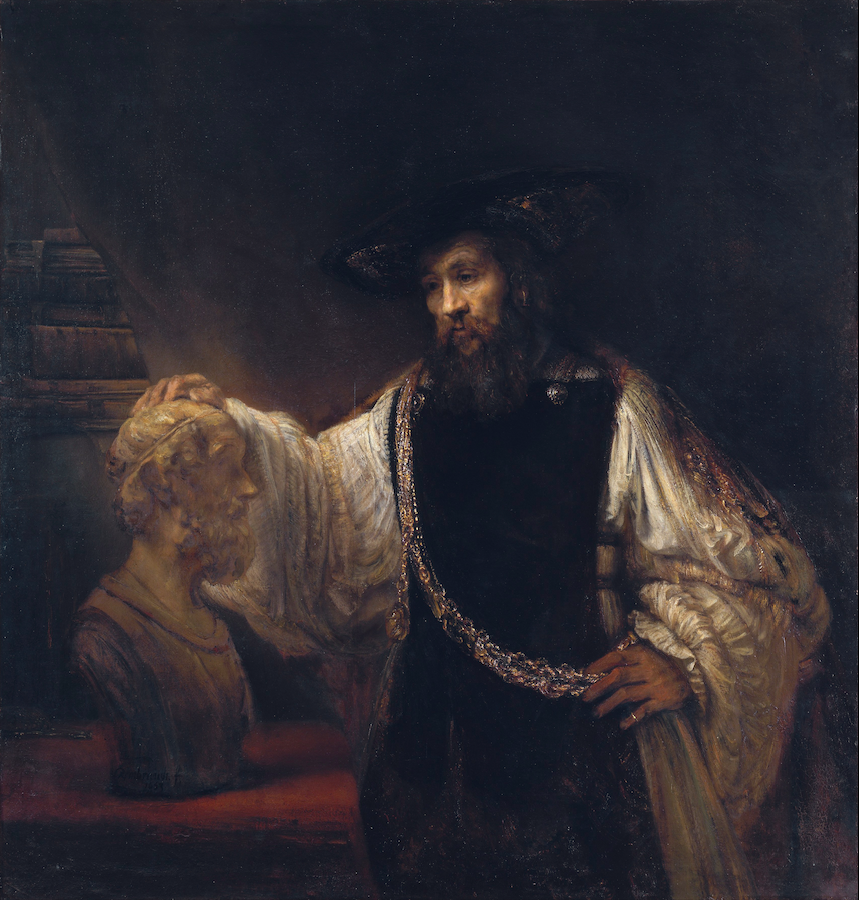
Aristotle Contemplating a Bust of Homer

Aristotle Contemplating a Bust of Homer
Aristotle Contemplating a Bust of Homer is an oil-on-canvas painting done by Rembrandt in 1653. The painting was commissioned by Rembrandt’s Sicilian patron named Don Antonio Ruffo, who did not request any particular subject.

The painting shows Aristotle, wearing a gold chain, resting his hand on a bust of blind Homer, a legendary figure from three centuries earlier, and thoughtfully looking at it. The gold chain that Aristotle is wearing is presumed to have an image of Alexander the Great. Some scholars have interpreted the painting as a morality tale—Aristotle, a successful and well-dressed courtier, is envying Homer who was blind but lived like a free spirit and did not have to wear any chain.

The painting was purchased by New York’s Metropolitan Museum of Art in 1961 for $2.3 million. 

Sunday, 26 May 2019

Strauss On Rousseau’s View of Man

Leo Strauss sees Rousseau as a modern Epicurean, an atheistic and materialistic thinker. On Rousseau’s Second Discourse (The Discourse on the Origin of Inequality), Strauss makes the following comment in his book Natural Right and History (Chapter 6: “The Crisis of Modern Natural Right”):

"The Second Discourse is meant to be a “history” of man. That history is modeled on the account of the fate of the human race which Lucretius gave in the fifth book of his poem. But Rousseau takes that account out of its Epicurean context and puts it into a context supplied by modem natural and social science. Lucretius had described the fate of the human race in order to show that that fate can be perfectly understood without recourse to divine activity. The remedies for the ills which he was forced to mention, he sought in philosophic withdrawal from political life. Rousseau, on the other hand, tells the story of man in order to discover that political order which is in accordance with natural right. Furthermore, at least at the outset, he follows Descartes rather than Epicurus: he assumes that animals are machines and that man transcends the general mechanism, or the dimension of (mechanical) necessity, only by virtue of the spirituality of his soul. Descartes had integrated the "Epicurean" cosmology into a theistic framework: God having created matter and established the laws of its motions, the universe with the exception of man's rational soul has come into being through purely mechanical processes; the rational soul requires special creation because thinking cannot be understood as a modification of moved matter; rationality is the specific difference of man among the animals. Rousseau questions not only the creation of matter but likewise the traditional definition of man. Accepting the view that brutes are machines, he suggests that there is only a difference of degree between men and the brutes in regard to understanding or that the laws of mechanics explain the formation of ideas. It is man's power to choose and his consciousness of his freedom which cannot be explained physically and which proves the spirituality of his soul."

Like Lucretius, Rousseau viewed man as naturally independent, self-sufficient, limited in his desires and, therefore, happy. He saw society as the creator of all the artificial desires and false opinions which gave rise to conflict and misery. Both Lucretius and Rousseau had a non-teleological view of man’s passage from nature into history.

Tuesday, 21 May 2019

On The Impact Of Language On Sensations

Henri Bergson is of the view that language gives a fixed form to the fleeting sensations that we experience. Here’s an excerpt from his book Time and Free Will (Chapter 2, “The Idea of Duration”):
Our simple sensations, taken in their natural state, are still more fleeting. Such and such a flavour, such and such a scent, pleased me when I was a child though I dislike them to-day. Yet I still give the same name to the sensation experienced, and I speak as if only my taste had changed, whilst the scent and the flavour have remained the same. Thus I again solidify the sensation; and when its changeableness becomes so obvious that I cannot help recognizing it, I abstract this changeableness to give it a name of its own and solidify it in the shape of a taste. But in reality there are neither identical sensations nor multiple tastes: for sensations and tastes seem to me to be objects as soon as I isolate and name them, and in the human soul there are only processes. What I ought to say is that every sensation is altered by repetition, and that if it does not seem to me to change from day to day, it is because I perceive it through the object which is its cause, through the word which translates it. This influence of language on sensation is deeper than is usually thought. Not only does language make us believe in the unchangeableness of our sensations, but it will sometimes deceive us as to the nature of the sensation felt. Thus, when I partake of a dish that is supposed to be exquisite, the name which it bears, suggestive of the approval given to it, comes between my sensation and my consciousness; I may believe that the flavour pleases me when a slight effort of attention would prove the contrary. In short, the word with well-defined outlines, the rough and ready word, which stores up the stable, common, and consequently impersonal element in the impressions of mankind, overwhelms or at least covers over the delicate and fugitive impressions of our individual consciousness. To maintain the struggle on equal terms, the latter ought to express themselves in precise words; but these words, as soon as they were formed, would turn against the sensation which gave birth to them, and, invented to show that the sensation is unstable, they would impose on it their own stability.
According to Bergson, the language that we use to analyze and describe our feelings leads to a distortion of the same feelings. We discern a certain kind of feelings as violent love or a deep melancholy because our immediate consciousness is overwhelmed by our language.

Monday, 20 May 2019

Leo Strauss on Thomas Hobbes

Leo Strauss views Thomas Hobbes as the creator of political hedonism and political atheism. In his book Natural Right and History, (Chapter 5, “Modern Natural Right”; Page 168-169), Strauss writes:

"Hobbes rejects the idealistic tradition on the basis of a fundamental agreement with it.  He means to do adequately what the Socratic tradition did in a wholly inadequate manner.  He means to succeed where the Socratic tradition had failed.  He traces the failure of the idealistic tradition to one fundamental mistake: traditional political philosophy assumed that man is by nature a political or social animal.  By rejecting this assumption, Hobbes joins the Epicurean tradition.  He accepts its view that man is by nature or originally an a-political and even an a-social animal, as well as its premise that the good is fundamentally identical with the pleasant.  But he uses that a-political view for a political purpose.  He gives that a-political view a political meaning.  He tries to instill the spirit of political idealism into the hedonistic tradition.  He thus became the creator of political hedonism, a doctrine which has revolutionized human life everywhere on a scale never yet approached by any other teaching.

"The epoch-making change which we are forced to trace to Hobbes was well understood by Edmund Burke: “Boldness formerly was not the character of atheists as such. They were even of a character nearly the reverse; they were formerly like the old Epicureans, rather an unenterprising race. But of late they are grown active, designing, turbulent, and seditious.” Political atheism is a distinctly modern phenomenon. No pre-modern atheist doubted that social life required belief in, and worship of, God or gods. If we do not permit ourselves to be deceived by ephemeral phenomena, we realize that political atheism and political hedonism belong together. They arose together in the same moment and in the same mind."

Saturday, 18 May 2019

Bergson on Two Sources of Morality and Religion

In his 1932-book Two Sources of Morality and Religion, Henri Bergson notes that the most societies are closed like a hive or an ant-hill. In closed societies, men are motivated by instinct and are indifferent to each other, and they are prepared to take defensive or offensive actions. In an open society, on the other hand, men are motivated by intelligence and are capable of embracing all humanity. From this definition, Bergson draws the analogy between a “closed morality,” which is a social morality that does not extend to all human beings but only to the group, and “open morality,” which embraces all humanity. On religion, Bergson says that there has never been a society without religion, and he differentiates between a "static" and "dynamic" religion. He draws a distinction between a “closed soul” and an “open soul” and gives the example of Socrates as an open soul who is concerned about entire humanity. He writes, “There was irony running through Socratic teaching, and outbursts of lyricism were probably rare; but in the measure in which these outbursts cleared the road for a new spirit, they have been decisive for the future of humanity.”

Here’s his description of the relationship between the closed soul and the open soul:

“Between the closed soul and the open soul there is the soul in process of opening. Between the immobility of a man seated and the motion of the same man running there is the act of getting up, the attitude he assumes when he rises. In a word, between the static and the dynamic there is to be observed, in morality too, a transition stage. This intermediate state would pass unnoticed if, when at rest, we could develop the necessary impetus to spring straight into action. But it attracts our attention when we stop short - the usual sign of insufficient impetus. Let us put the same thing in a different way. We have seen that the purely static morality might be called infra-intellectual, and the purely dynamic, supra-intellectual. Nature intended the one, and the other is a contribution of man's genius. The former is characteristic of a whole group of habits which are, in man, the counterpart of certain instincts in animals; it is something less than intelligence. The latter is inspiration, intuition, emotion, susceptible of analysis into ideas which furnish intellectual notations of it and branch out into infinite detail; thus, like a unity which encompasses and transcends a plurality incapable of ever equalling it, it contains any amount of intellectuality; it is more than intelligence. Between the two lies intelligence itself. It is at this point that the human soul would have settled down, had it sprung forward from the one without reaching the other. It would have dominated the morality of the closed soul; it would not have attained to, or rather it would have not have created, that of the open soul. Its attitude, the result of getting up, would have lifted it to the plane of intellectuality.”

Monday, 13 May 2019

MacIntyre On Character and Intelligence

In his book After Virtue, Alasdair MacIntyre notes that for Aristotle character is inseparable from intelligence. Here’s an excerpt from Chapter 12, “Aristotle’s Account of Virtues” (Page 154-155):

“According to Aristotle then excellence of character and intelligence cannot be separated. Here Aristotle expresses a view characteristically at odds with that dominant in the modern world. The modern view is expressed at one level in such banalities as ‘Be good, sweet maid, and let who will be clever’ and at another in such profundities as Kant’s distinction between the good will, the possession of which alone is both necessary and sufficient for moral worth, and what he took to be a quite distinct natural gift, that of knowing how to apply general rules to particular cases, a gift the lack of which is called stupidity. So for Kant one can be both good and stupid; but for Aristotle stupidity of a certain kind precludes goodness. Moreover genuine practical intelligence in turn requires knowledge of the good, indeed itself requires goodness of a kind in its possessor: '... it is clear that a man cannot have practical intelligence unless he is good’.”

According to MacIntyre, modern social practice and theory follows Kant rather than Aristotle: “It is indeed difficult to envisage the exaltation of bureaucratic expertise in any culture in which the connection between practical intelligence and the moral virtues is firmly established.”

Saturday, 11 May 2019

On The Role of Senses and Freedom of the Mind

In his essay, “Good Sense and Classical Studies,” (Henri Bergson: Key Writings; page 422), Henri Bergson says:

"The role of our senses, in general, is not so much to give us knowledge of material objects as to signal their utility to us. We taste flavours, we breathe odours, we distinguish hot and cold, darkness and light. But science tells us that none of these qualities belong to objects in the form that we apprehend them; they only tell us in their picturesque language the inconvenience or advantage that things have for us, the services they could render us, the dangers they could lead us into. Our senses thus serve us, above all, to orient us in space; they are not turned towards science, but towards life. But we do not only live in a material milieu, but also in a social milieu. If all of our movements are transmitted in space and thus disturb part of the physical universe, by contrast most of our actions have their immediate or far-reaching consequences, good or bad, first of all for us, then for the society that surrounds us. Foreseeing [prevoir] these consequences, or rather having a presentiment of them [pressentir]; distinguishing the essential from the inessential or indifferent in matters of behaviour; choosing from the various possible courses of action the one which will produce the greatest amount of attainable rather than imaginable good: this is, it seems to me, the role of good sense. It is thus indeed a sense in its own way; but while the other senses place us in relation to things, good sense presides over our relations with persons." (This essay is an address delivered by Bergson at the Great Ampitheatre of the Sorbonne, July 30, 1895.)

Here's Bergson view of freedom of the mind:

"One of the greatest obstacles, we were saying, to the freedom of the mind, are the ideas that language gives to us ready-made, and that we breathe, so to speak, in the environment which surrounds us. They are never assimilated with our substance: incapable of participating in the life of the mind, they persevere, as truly dead ideas, in their stiffness and immobility. Why then do we so often prefer them to those which are living and vibrant? Why does our thought, instead of working to become master of itself, prefer to exile itself from itself? It is firstly through distraction, and by dint of amusing ourselves along the road, we no longer know where we wanted to go."

Friday, 10 May 2019

Bergson On The Meaning of The Comic

Henri Bergson’s 1911 book Laughter: An Essay on the Meaning of the Comic is a collection of three essays which explore why people laugh and what laughter means, especially laughter that is caused by comical acts. Here’s an excerpt from the first essay, “The Comic in General — The Comic Element in Forms and Movements — Expansive Force of the Comic”:

"The first point to which attention should be called is that the comic does not exist outside the pale of what is strictly human. A landscape may be beautiful, charming and sublime, or insignificant and ugly; it will never be laughable. You may laugh at an animal, but only because you have detected in it some human attitude or expression. You may laugh at a hat, but what you are making fun of, in this case, is not the piece of felt or straw, but the shape that men have given it,—the human caprice whose mould it has assumed. It is strange that so important a fact, and such a simple one too, has not attracted to a greater degree the attention of philosophers. Several have defined man as "an animal which laughs." They might equally well have defined him as an animal which is laughed at; for if any other animal, or some lifeless object, produces the same effect, it is always because of some resemblance to man, of the stamp he gives it or the use he puts it to."

Bergson sees laughter is a social gesture which inspires people to avoid eccentricity and be normal. In his first essay, he notes: “By the fear which it inspires, it restrains eccentricity, keeps constantly awake and in mutual contact certain activities of a secondary order which might retire into their shell and go to sleep, and, in short, softens down whatever the surface of the social body may retain of mechanical inelasticity.”

Wednesday, 8 May 2019

William James and Henri Bergson

William James, a senior to Henri Bergson by 17 years, had a high opinion of Bergson's work. In his 1909 book The Pluralistic Universe, James writes: “If I had not read Bergson, I should probably still be blackening endless pages of paper privately, in the hope of making ends meet that were never meant to meet, and trying to discover some mode of conceiving the behavior of reality which should leave no discrepancy between it and the accepted laws of the logic of identity. It is certain, at any rate, that without the confidence which being able to lean on Bergson's authority gives me I should never have ventured to urge these particular views of mine upon this ultra-critical audience.” Here’s an excerpt from James’s letter to Bergson on June 13, 1907:
O my Bergson, you are a magician, and your book is a marvel, a real wonder in the history of philosophy, making, if I mistake not, an entirely new era in respect of matter, but unlike the works of genius of the “transcendentalist” movement (which are so obscurely and abominably and inaccessibly written), a pure classic in point of form. You may be amused at the comparison, but in finishing it I found the same after-taste remaining as after finishing “Madame Bovary,” such a flavor of persistent euphony, as of a rich river that never foamed or ran thin, but steadily and firmly proceeded with its banks full to the brim. Then the aptness of your illustrations, that never scratch or stand out at right angles, but invariably simplify the thought and help to pour it along! Oh, indeed you are a magician! And if your next book proves to be as great an advance on this one as this is on its two predecessors, your name will surely go down as one of the great creative names in philosophy. 

There! have I praised you enough? What every genuine philosopher (every genuine man, in fact) craves most is praise — although the philosophers generally call it “recognition”! If you want still more praise, let me know, and I will send it, for my features have been on a broad smile from the first page to the last, at the chain of felicities that never stopped. I feel rejuvenated. 
As to the content of it, I am not in a mood at present to make any definite reaction. There is so much that is absolutely new that it will take a long time for your contemporaries to assimilate it, and I imagine that much of the development of detail will have to be performed by younger men whom your ideas will stimulate to coruscate in manners unexpected by yourself. To me at present the vital achievement of the book is that it inflicts an irrecoverable death-wound upon Intellectualism. It can never resuscitate! But it will die hard, for all the inertia of the past is in it, and the spirit of professionalism and pedantry as well as the aesthetic-intellectual delight of dealing with categories logically distinct yet logically connected, will rally for a desperate defense. The élan vital, all contentless and vague as you are obliged to leave it, will be an easy substitute to make fun of. But the beast has its death-wound now, and the manner in which you have inflicted it (interval versus temps d'arrêt, etc.) is masterly in the extreme. I don’t know why this later redaction of your critique of the mathematics of movement has seemed to me so much more telling than the early statement — I suppose it is because of the wider use made of the principle in the book. (The Letters of William James, Edited by his son Henry James; Page 290-294)
James is talking about Bergson's Creative Evolution and in a later section of the letter, he informs Bergson about his own book Pragmatism: “You will be receiving my own little “pragmatism” book simultaneously with this letter. How jejune and inconsiderable it seems in comparison with your great system! it seems in comparison with your great system! But it is so congruent with parts of your system, fits so well into interstices thereof, that you will easily understand why I am so enthusiastic. I feel that at bottom we are fighting the same fight, you a commander, I in the ranks.”

Monday, 6 May 2019

Enlightenment Endangers Philosophy

Allan Bloom in his “Interpretative Essay,” (The Republic of Plato; Page 392):

“Socrates teaches that wisdom and political power are distinct. Their coming together can only be due to the coincidence that a man who is wise happens also to be a ruler, thus uniting the two things; nothing in their two natures leads the one to the other. Political power serves the passions or desires of the members of a city, and a multitude cannot philosophize. It may use the results of science or philosophy, but it will use them to its own ends and will thereby distort them. Moreover, the wise man by himself is more of a threat to a regime than a helper. Intellectual progress is not the same as political progress, and, because there is not a simple harmony between the works of the mind and the works of the city, the philosopher without power must remain in an uneasy relationship with the city and its beliefs. Enlightenment endangers philosophy because it tempts philosophers to sacrifice their quest for the truth in favor of attempting to edify the public; in an "enlightened" world, philosophy risks being made a tool of unwise and even tyrannical regimes, thus giving those regimes the color of reason and losing its function as the standard for criticism of them.”

Saturday, 4 May 2019

Allan Bloom on Plato’s Allegory of the Cave

In his interpretive essay on Plato’s the Republic, Allan Bloom offers an interpretation of the Platonic Allegory of the Cave. Here’s an excerpt:

“After initiating Glaucon into the mysteries of this divine beauty, Socrates turns to an elaboration of the relationship of the philosophic soul to the city. The divided line described the soul's progress from its lowest level of cognition, imagination, to trust, thought, and finally intellection, its highest level. But now Socrates makes clear that this is not a simple movement depending only on talent and effort. There are powerful forces that stand in the way of the philosophic quest. The discovery of that quest has the character of a liberation from bondage. In the most moving of all his many images, Socrates compares our situation to that of prisoners in a cave. We are surrounded by darkness, our only access to ourselves and the world coming from the observation of shadows on the wall. But, although there is darkness, there is also a light in the cave; the pale shadows we possess are made possible by that light. Moreover, a few human beings can emerge from the cave. Our lives are a combination of ugliness and sublime possibility. The Enlightenment, taken literally, believed that the light could be brought into the cave and the shadows dispelled; men, in that view, could live in perfect light. This Socrates denies; the philosopher does not bring light to the cave, he escapes into the light and can lead a few to it; he is a guide, not a torchbearer. The attempt to illuminate the cave is self-defeating: a part of man craves the shadows. The light would be dimmed and distorted; it would not provide real clarity within the cave. And, at the same time, those who have the urge to ascend to the light would be discouraged from the endeavor by the myth, apparently based on reason, that there is no other light to which they can ascend. Thus the only source of liberation and inspiration would disappear from the cave. The Enlightenment teaches that the cave can be transformed; Socrates teaches that it must be transcended and that this transcendence can be accomplished only by a few.” ~ (“Interpretative Essay”; The Republic of Plato by Allan Bloom; Page 402-403)

Friday, 3 May 2019

Voegelin on Nietzsche’s Last Man

There is a resistance to transforming into the Nietzschean overman—this challenge will not be acceptable to most men. They would rather live as the antithesis to the overman, the Nietzschean Last Man. In his essay, "Nietzsche, the Crisis, and the War" (Journal of Politics, 1944), Eric Voegelin talks about the Last Man:

"The refusal of the challenge can assume various forms which, in part, are determined by the time position of the evading person. A first form has been characterized by Nietzsche himself in the symbol of the “Last Man.” Zarathustra preaches the gospel of the superman to the people, and the people are silent. He then tries to arouse them by an appeal to their pride and draws the picture of the most contemptible, of the Last Man, whom they will be unless they overcome their present state. The Last Man is the man without creative love, without creative imagination, without a desire for anything that is more than himself. “What is a star?” asks the last man, and he is satisfied with his little pleasures and the comforts of his existence. What he wants is: some warmth, some neighborliness, not too much work, protection against disease, a sufficient measure of drugs to create pleasant dreams (liquor, movies, radio), no poverty but not too much wealth. He wants to know what is going on and to thrash it out; all want the same and want to be equal; he who feels different goes voluntarily into the insane asylum; “formerly all the world was insane”—say the most subtle and leer; one has a pleasure for the day and a pleasure for the night— but with restraint, for the last man is concerned about health and wants a long life. “ ‘We have invented happiness’—say the last men and leer.” At this point of the speech the audience breaks out in enthusiasm: “Oh, give us this last man—make us these last men. You can have then your superman!” and they laughed. “But there is ice in their laughter,” adds Nietzsche, having diagnosed correctly the schizophrenic touch of the man who is last because he is lost spiritually."

The popularity of the Last Man leads to despiritualized existence or nihilism which is the a cause of brutality and war. “The evasion of the challenge through derision and through acceptance of the despiritualized existence is, however, a short-lived possibility. When the organizing power of the spirit becomes weak, the result is not a peaceably happy despiritualized society, but a chaos of instincts and values. Despiritualized happiness is the twin brother of despiritualized brutality; once the spiritual order of the soul is dissolved in happiness, it is only a question of time and circumstance when and from which quarter the attack on an order without dignity will begin.” 

Wednesday, 1 May 2019

Exercise of Reason Preceded the Philosophy of Reason

Brand Blanshard in Reason & Analysis (Page 52):

“Indeed men seem to have been exercising the reason we have just described for at least five hundred thousand years before they had anything like an adequate idea of what being reasonable meant. Aristotle, who struggled long to achieve such an idea, pointed out that what was first in order of nature may be last in order of recognition; and he would certainly have agreed with Locke’s remark that ‘God has not been so sparing to men, to make them barely two-legged animals, and left it to Aristotle to make them rational.’ But while rational practice may be developed independently of theory, the theory of reason does depend on a developed practice; it is only with instances of an accomplished use of reason before them that philosophers have ever succeeded in giving an account of that use. The great advances in understanding what reason means have accompanied or shortly followed bursts of reflective activity."

In the next passage, Blanshard points out: "When man escaped from the animal mind, his use of reason seems to have been concentrated for some hundreds of millenniums on the connection of means to end.” (Page 52)

Tuesday, 30 April 2019

On the Absence of Dogmatism in Socrates

Socrates was not a dogmatic thinker. He was tolerant and open-minded. In the Platonic dialogues, he is willing to hear the other side; he listens to objections, gives others a chance to express their ideas, and often points out that it is important go on learning. Here’s an excerpt from Allan Bloom's “Interpretive Essay,” in his book The Republic of Plato (Page 331): "The intellectual voice of the city can become tractable as the city never will. The Republic, a book about a perfect city, is characterized by having perfect interlocutors, that is, men without whom a city could not be founded and who are, at the same time, persuadable, whom argument can convince to adapt to a new kind of world which is contrary to their apparent advantage. Just as one must have almost unbelievable conditions to found the best city in deed, so one must have exceptional interlocutors to found it in speech."

Monday, 29 April 2019

Eric Voegelin on Karl Popper: Rascally, Impertinent, Loutish

Leo Strauss and Eric Voegelin were contemptuous of Karl Popper’s work on political theory The Open Society and Its Enemies. They believed that Popper’s depiction of Plato as a philosopher of totalitarianism was scandalous and a complete fabrication. In the 1950s, Popper was auditioning for an appointment at the University of Chicago. This alarmed Strauss. In his letter dated April 10, 1950, Strauss wrote to Voegelin: "May I ask you [Voegelin] to let me know sometime what you think of Mr. Popper. He gave a lecture here [at the University of Chicago], on the task of social philosophy, that was beneath contempt: it was the most washed-out, lifeless positivism trying to whistle in the dark, linked to a complete inability to think "rationally," although it passed itself off as "rationalism" -- it was very bad. I cannot imagine that such a man ever wrote something worthwhile reading, and yet it appears to be a professional duty to become familiar with his productions."

Voegelin replied in just eight days. In his letter dated April 18, 1950, he wrote: "The opportunity to speak a few deeply felt words about Karl Popper to a kindred soul is too golden to endure a long delay. This Popper has been for years, not exactly a stone against which one stumbles, but a troublesome pebble that I must continually nudge from the path, in that he is constantly pushed upon me by people who insist that his work on the “open society and its enemies” is one of the social science masterpieces of our times. This insistence persuaded me to read the work even though I would otherwise not have touched it. You are quite right that it is a vocational duty to make ourselves familiar with the ideas of such a work when they lie in our field; I would hold out against this duty the other vocational duty, not to write and publish such a work. In that Popper violated this elementary vocational duty and stole several hours of my lifetime, which I devoted in fulfilling my vocational duty, I feel completely justified in saying without reservation that this book is impudent, dilettantish crap. Every single sentence is a scandal, but it is still possible to lift out a few main annoyances."

Voegelin listed four major flaws in Popper’s work. His complete letter can be read here. He summed up his argument against Popper in these lines: "Popper’s book is a scandal without extenuating circumstances; in its intellectual attitude it is the typical product of a failed intellectual; spiritually one would have to use expressions like rascally, impertinent, loutish; in terms of technical competence, as a piece in the history of thought, it is dilettantish, and as a result is worthless." It took Strauss a few months to write a reply. He thanked Voegelin for the detailed letter on the problems in Popper’s thesis and revealed that he had taken the liberty of showing Voegelin’s letter to an in influential colleague “who was thereby encouraged to throw his not inconsiderable influence into the balance against Popper’s probable appointment here [at the University of Chicago]. You thereby helped to prevent a scandal.”

Saturday, 20 April 2019

On Rewriting the Past

Milan Kundera in The Book of Laughter and Forgetting:
"People are always shouting they want to create a better future. It's not true. The future is an apathetic void of no interest to anyone. The past is full of life, eager to irritate us, provoke and insult us, tempt us to destroy or repaint it. The only reason people want to be masters of the future is to change the past. They are fighting for access to the laboratories where photographs are retouched and biographies and histories rewritten." (Part I; "Lost Letters"; Page 22)
Kundera's The Book of Laughter and Forgetting deals with the theme of the Czechoslovakians opposing the communist regime in different ways. He shows that to laugh and to forget are political acts, as the angels and devils are the embodiment of political beings.

Friday, 19 April 2019

Strauss on Hobbes and Origins of Modernity

Leo Strauss notes that Thomas Hobbes cannot be ignored because he is the originator of modernity. Here’s an excerpt from his essay, “On the Basis of Hobbes’s Political Philosophy,” (Chapter 7; What is Political Philosophy? by Leo Strauss):

"Nietzsche, who abhorred the modern ideas, saw very clearly that those ideas are of British origin. The admirer of Schopenhauer thought it equitable to look down with contempt on the British philosophers, in particular on Bacon and on Hobbes. Yet Bacon and Hobbes were the first philosophers of power, and Nietzsche’s own philosophy is philosophy of power. Was not “the will to power” so appealing because its true ancestry was ignored? Only Nietzsche’s successors restored the connection, which he had blurred, between the will to power and technology. But this connection is clearly visible in the origins of that philosophic tradition which Nietzsche continued or competed: the British tradition.

"It has become necessary to study Hobbes as the originator of modernity, i.e., to take his claim seriously. That is to say, if we understand ourselves correctly, we see that our perspective is identical with Hobbes’s perspective. Modern philosophy emerged in express opposition to classical philosophy. Only in the light of the quarrel between the ancients and the moderns can modernity be understood. By rediscovering the urgency of this quarrel, we return to the beginnings of modernity. Our perspective becomes identical with that of Hobbes, in so far as his perspective is not limited by his answer, the acceptance of the modern principle, but extends to his question, which is the quarrel between the ancients and the moderns."

Strauss sees Hobbes as a thinker who broke with the pre-modern heritage and ushered in a new type of social doctrine: the doctrine of modernity.

Thursday, 11 April 2019

Firefly Theme Song: The Ballad of Serenity

Take my love, take my land,
Take me where I cannot stand.
I don't care, I'm still free,
You can't take the sky from me.

Take me out to the black,
Tell them I ain't comin back.
Burn the land and boil the sea,
You can't take the sky from me.

There's no place, I can be,
Since I've found Serenity.
But you can't take the sky from me.

~ Written by Joss Whedon and performed by Sonny Rhodes

Saturday, 6 April 2019

Strauss on Success and Truth

In his discussion of the connection between historical knowledge and political philosophy, Leo Strauss says: "If, however, we do not worship “success” as such, we cannot maintain that the victorious cause is necessarily the cause of truth. For even if we grant that truth will prevail in the end, we cannot be certain that the end has already come." ~ (What is Political Philosophy? And Other Studies by Leo Strauss; Page 61). I think this is a fine point—history has no beginning or an end and therefore the old cliche that truth will prevail in the end has no meaning.

Friday, 5 April 2019

Leaving the Yellow House

An elderly and self-destructive dipsomaniac lives in a yellow house. She is lonely, prone to self-deception, and incapable of talking care of herself. Some of her neighbors tell her that they will care for her if she leaves her house to them. But she does not want to give them the house. When her condition worsens after an accident, she is forced to look back into her past and examine the key events. She thinks of many people but she is unable to remember anyone to whom she can leave the house. Finally, she decides to leave the house to the only person that she cares for—herself.

Here’s an excerpt from the letter that she writes to her lawyer:

“It is too soon! Too soon! Because I do not find it in my heart to care for anyone as I would wish. Being cast off and lonely, and doing no harm where I am. Why should it be? This breaks my heart. In addition to everything else, why must I worry about this, which I must leave? I am tormented out of my mind. Even though by my own fault I have put myself into this position. And I am not ready to give up on this. No, not yet. And so I’ll tell you what, I leave this property, land, house, garden and water rights, to Hattie Simmons Waggoner. Me! I realize this is bad and wrong. It cannot happen. Yet it is the only thing I really wish to do, so may God have mercy on my soul.”

After writing the letter to her lawyer, she goes to bed. Her last thoughts, before she falls asleep: “But I won’t be selfish from the grave. I’ll think again tomorrow.” Saul Bellow’s Leaving the Yellow House is a pessimistic story, but I think most readers can empathize with the protagonist Hattie Simmons Waggoner.